
By Chona · Published September 24, 2026
Three Gaps. Thirty Minutes to Fix. A Real Service You Can Sell Monday.
We checked the websites of 17 beauty salons and spas in Phoenix listed in OpenStreetMap in September 2026 — this is a sample, not every salon in the city — and 73% of the 15 that loaded had no local-business structured data. That is the invisible code Google reads to display a business’s hours, address, and services in search results. When it is missing, Google either guesses or skips the business entirely in local packs.
That gap is a service. You find salons with broken or missing SEO signals, fix them in a weekend using AI and free tools, and charge $150–$350 per project. No coding degree. No agency. Just a laptop, a cold email, and the exact steps below.
Before You Start: What You Need
- A free Google account (for Google’s Rich Results Test and Google Search Console access if the client shares it)
- A ChatGPT account — the free tier is enough for generating structured data markup and meta descriptions
- A text editor (Notepad, Google Docs, or any plain-text app) to paste and deliver code
- Access to the client’s website backend — Wix, Squarespace, WordPress, or GoDaddy Website Builder (the four platforms we saw in our Phoenix sample)
- Two hours for your first audit-and-fix; about 45 minutes once you have done three of these
You do not need to be a developer. Every platform above has a settings panel or a code-embed block where structured data can be added without touching raw HTML. Wix calls it “Custom Code” under Settings → Custom Code. Squarespace calls it “Code Injection.” WordPress uses a free plugin called Rank Math or Yoast SEO. GoDaddy Website Builder has a “Website Settings” area with an SEO tab.
Step 1: Find Your First Five Prospects
Open OpenStreetMap and search “beauty salon” or “spa” in the city you are targeting. Click each result and note the website URL. Skip national chains — Great Clips, Massage Envy, European Wax Center — because their sites are managed centrally and you cannot help them. You want independently owned shops with their own website.
You need five prospects to start. Aim for ten if you want to land two clients in your first week. Our Phoenix data showed that 2 of 17 listed businesses had no working website at all — those are not prospects, move on.
Open each website and answer four questions in under five minutes per site:
- Does Google’s Rich Results Test show valid LocalBusiness schema? (Paste the URL at search.google.com/test/rich-results — a “No items detected” result is a gap you can sell.)
- Is the phone number a tappable link on mobile? (Open the site on your phone and tap the number — if nothing happens, it is plain text, not a link.)
- Is there an online booking button? (Our data: 47% of the Phoenix sites had none.)
- What does the site look like in a Google search result? (Type site:theirurlhere.com into Google and read the snippet — if it starts with generic filler or a truncated address, there is no meta description.)
Log your findings in a simple spreadsheet: business name, website, and a Y/N for each of those four checks. Any business with two or more N’s is a warm prospect.
Step 2: Run the Full Audit in 30 Minutes
For each warm prospect, go deeper. Here is the full checklist we used on the Phoenix sample — the same gaps that showed up across 73%, 57%, 53%, and 47% of sites.
The data table above shows every measure we recorded. The four gaps worth selling are: missing structured data (73%), outdated or missing meta descriptions (33%), no tap-to-call phone link (53%), and no online booking (47%). Those are your four line items.
For structured data specifically, use Google’s Rich Results Test and also paste the URL into Schema.org’s Validator. Both are free and give you a clear pass/fail. A pass here means Google can reliably surface the salon’s hours, location, and service categories in local search — a fail means it cannot.
Step 3: Fix the Gaps With AI — The Exact Prompts
Here is where AI does the heavy lifting. You are not writing JSON by hand. You are giving ChatGPT the salon’s real information and asking it to generate publish-ready markup.
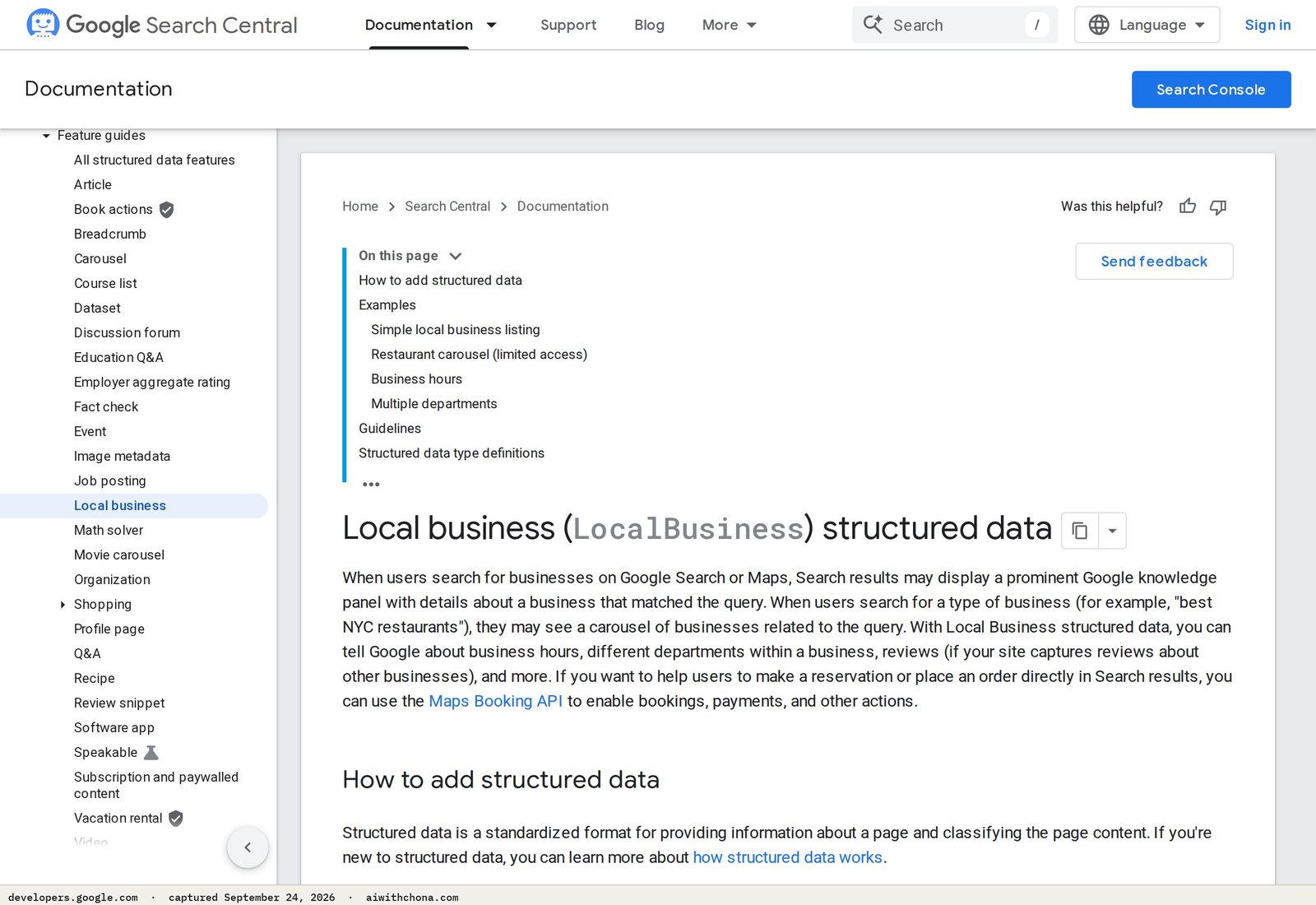
Prompt 1: Generate LocalBusiness Structured Data
You are a local SEO specialist. Generate valid JSON-LD structured data
for a LocalBusiness using the following details. Follow the schema.org
LocalBusiness and BeautySalon types. Output only the JSON-LD script block,
no explanation.

Business name: [NAME]
Address: [STREET, CITY, STATE, ZIP]
Phone: [PHONE]
Website: [URL]
Business hours: [e.g. Mon-Sat 9am-7pm, Sun 10am-5pm]
Services offered: [e.g. haircuts, highlights, balayage, waxing, facials]
PriceRange: [e.g. $$]
Google Maps URL: [PASTE THE MAPS LINK]
Paste the output into the site’s custom code section. Validate it immediately in Google’s Rich Results Test before you call it done. If the test shows errors, paste the error message back into ChatGPT and ask it to fix the specific field flagged.
Prompt 2: Write a Meta Description
Write a Google meta description for a beauty salon called [NAME]
in [CITY, STATE]. It must be under 155 characters, include the city name,
and end with a clear action — either 'Book online' or 'Call us today.'
Mention one or two of their most popular services: [LIST SERVICES].
Write 3 variations.
Give the client all three and let them pick. It takes two minutes to paste the chosen one into the site’s SEO settings panel — every platform above has one.
Fix 3: Tap-to-Call Link
This is not an AI task — it is a one-line HTML edit. Find the phone number in the site editor and change the display text to a link using this format:
<a href="tel:+16025550123">(602) 555-0123</a>
On Wix and Squarespace, you can also use the built-in “Button” element, set the action to “Phone,” and type in the number — no HTML required.
Fix 4: Online Booking
If the salon already uses a booking platform — Vagaro, Fresha, Square Appointments, or Booksy — they have an embeddable widget or a booking link you can add as a button. Ask the owner which platform they use, grab the embed code from that platform’s dashboard, and drop it into the site. If they have no booking system at all, recommend Fresha (fresha.com), which has a free plan for independent salons, and set it up as a separate $75–$100 add-on task.
What to Charge for a Local SEO Fix-Up
Here is the honest pricing breakdown, with the driver at each level:
- $150 — owner provides all business info, you fix structured data and meta description only, one revision included. This is your beginner rate while you are building speed.
- $250 — structured data, meta description, tap-to-call fix, and booking button added. Owner provides the content. One round of revisions.
- $350 — everything above plus you write the service descriptions used in the structured data, write all three meta description variants and recommend one, and do a 30-minute follow-up call two weeks later to check indexing. This is your rate once you have delivered three projects.
- $75–$100 add-on — setting up a new Fresha or Square Appointments account from scratch if they have no booking system.
Worked example: three clients at $250 each = $750. Subtract $20/month for ChatGPT Plus (if you upgrade) and $0 for tools since everything else is free = $730 net for roughly six to eight hours of total work across all three. That is not a promise — it is the math at this price point if you land three clients.
For context on the time: your first project will take about two hours. By the third, expect 45 minutes to an hour. The audit itself — running the four checks — takes 20 minutes per site once you have the checklist memorized.
If you want to pair this with ongoing social content or graphics work for the same salon, see our Sell AI Social Media Graphics: $300/Mo Playbook — that is a natural upsell once you have an existing relationship.
How to Land Your First Client: The Exact First Message
Email works better than Instagram DMs for this service because you are referencing their website — owners take it more seriously in their inbox. Find the email on their contact page or Google Business Profile.
Subject: Quick website issue I spotted for [SALON NAME]

Hi [NAME],

I was looking up beauty salons in [CITY] and checked your website —
you have a strong-looking site, but Google can't currently read your
business hours or services because the site is missing local structured data.
That's one reason you may not be showing up in the "near me" results
as often as you should.

I fix this for independent salons in [CITY] — it takes me about two days
and I charge $200 for the full correction (structured data, your Google
search snippet, and a tap-to-call phone link). No monthly fees, no contract.

Want me to send you a quick before/after showing exactly what changes?

[YOUR NAME]
[YOUR PHONE OR WEBSITE]
Personalize the salon name and one specific detail you noticed — “I saw your copyright still says 2024” or “your phone number isn’t tappable on mobile” — and your reply rate will be meaningfully higher than a generic pitch. Our data showed 57% of Phoenix sites with a copyright line still showed 2024 or earlier; that is a specific, quotable fact an owner will recognize immediately.
Send 10 emails on Monday. Follow up once on Thursday if no reply. Send to the next 10 the following Monday. Most people land their first client between message 15 and 30. The people who land two clients in 90 days sent at least 30 outreach messages — that is the honest separator between the two ends of the range.
For more on building a lean outreach system without burning out, the post on why AI side hustles fail by month two is worth reading before you start — it covers the exact mistake most beginners make in the first 60 days.
What Goes Wrong — and the Fix
Problem 1: The owner says “my web designer handles that”
Reply: “Totally understand — if you want, I can put together a one-page summary of the specific issues and you can forward it to them. No charge for that.” This keeps the door open. Half the time the designer is unresponsive and the owner comes back to you within two weeks.
Problem 2: The structured data validates but Google doesn’t show it
Structured data can take two to four weeks to appear in search results after Google re-crawls the page. According to Google’s structured data documentation, validation confirms the markup is correct — indexing is a separate, time-gated process. Tell the client this upfront so they are not expecting overnight results. Offer to check back in three weeks and send a screenshot of the Rich Results Test showing the data is live and valid.
Problem 3: The site platform won’t let you add custom code
GoDaddy’s basic plan blocks custom code injection. If the client is on GoDaddy’s free or Starter tier, you have two options: recommend they upgrade to the Basic plan ($9.99/mo as listed on GoDaddy’s pricing page at the time of writing) which unlocks the SEO settings, or use a platform-native workaround — GoDaddy’s built-in SEO wizard covers the meta description and basic business info, just not the full JSON-LD block. Scope your quote accordingly and explain the limitation before you start.
The Realistic First-90-Days Picture
Most beginners land zero to two clients in the first 90 days. Zero happens when outreach volume stays under 20 messages total — the math just does not work at that volume. Two clients happen when you send 30 or more messages, follow up consistently, and deliver the first project cleanly enough that the client refers you to a neighbor salon.
At $250 per project, two clients = $500. That is not a side income that replaces a job — it is proof the service works and a portfolio entry that makes the next pitch easier. Month four and five, with a few referrals and a polished process, is when the numbers start to compound.
If you want to see how this fits into a broader AI service stack without overspending on tools, the Best Free AI Stack for Service Business: Under $20/Mo guide shows exactly what to pay for and what to skip.
Local Lead Machine pulls local businesses from Google Places, scores who most likely needs a website, and drafts a first message grounded in each listing. A script, not a course.
Frequently Asked Questions
Do I need to know how to code to sell a local SEO fix-up for beauty salons?
No. The structured data is generated by ChatGPT from information you collect from the owner, and every major website platform — Wix, Squarespace, WordPress, and GoDaddy Website Builder — has a settings panel or code-embed area where you paste it in without writing a single line by hand. The tap-to-call fix is one line of HTML that you copy from a template. The meta description goes into a text field in the site’s SEO settings. None of it requires a developer background, and your first complete fix should take under two hours.
How do I prove to a salon owner that their site has a problem?
Take a screenshot of Google’s Rich Results Test showing “No items detected” for their URL, and a screenshot of what their site looks like in a Google search result — specifically the auto-generated snippet Google writes when there is no meta description. Both are visual, non-technical, and immediately legible to a business owner. You can also show them their phone number on mobile and demonstrate that tapping it does nothing. Seeing the problem is more persuasive than reading about it.
Is this a one-time service or can I charge monthly?
The fix-up itself is a one-time project. To convert it into a monthly retainer, bundle it with ongoing work: monthly Google Business Profile updates, a weekly social post, or a quarterly SEO check-in where you review rankings and flag new issues. A $75–$150/month retainer for that maintenance work is realistic once you have delivered the initial fix and the owner trusts you. Do not pitch the retainer before the first project is done — earn the right to the ongoing relationship first.
What if the salon already has a Google Business Profile — does structured data still matter?
Yes, and they are two separate things. A Google Business Profile (the listing that appears in Google Maps and the local pack) is managed inside Google’s own system. Structured data on the salon’s website is what Google reads when someone lands on the site or when Google decides how to display the site in organic search results. According to Google’s LocalBusiness structured data documentation, the markup helps Google understand the business’s services, hours, and location for web search — separate from the Maps listing. Most salons have one but not the other.
Can I target cities other than Phoenix with this approach?
Yes. Our data is from Phoenix, but the gaps we measured — missing structured data, no tap-to-call, no meta descriptions — are not unique to that market. Independent beauty salons and spas in any mid-size or large US city are likely to show similar patterns because they are typically built by the owner or a generalist designer who prioritized looks over technical SEO. Pick your own city, run the same OpenStreetMap search, and build your own five-prospect list in an afternoon.
The next step is simple: open OpenStreetMap, search beauty salons in your city, and run the four-check audit on the first five sites you find. By the time you finish, you will know exactly which business to email first — and you will have the script above ready to send.
Grab the free AI Quick-Start guide — the exact tools and first steps that actually work, no fluff. Straight to you.